
Minimum lot sizes and frontages need to go.
Density caps already control the number of lots allowed on a site. Minimum lot sizes are redundant — and they kill good design. Leave it to the designer and developer to optimize each individual site.
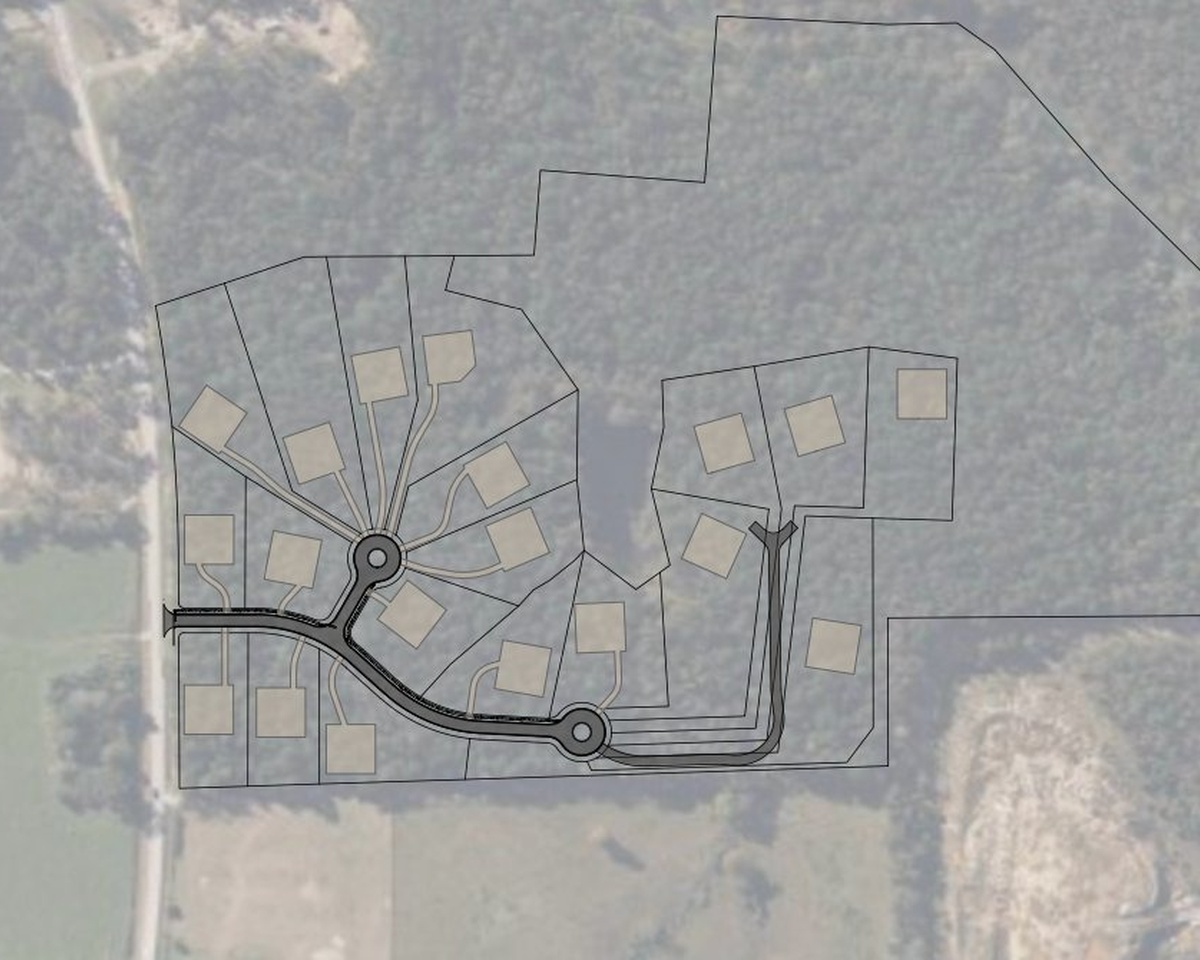
Case in point: Estates at Arbor Woods
Sixty acres in Auburn, thirty of them in floodplain. Under a conventional template — three-acre minimums, standard frontages — you’d mass-grade the uplands, push roads through the trees, and still end up fighting the floodplain for every lot.
Instead, using Auburn’s Conservation Overlay, we held density at 0.33 lots per acre but waived the 3-acre minimum lot size. Same number of homes the ordinance always allowed. Radically different outcome:
- No mass grading — lots placed where the land wanted them.
- Trees preserved — the character that makes estate lots worth estate prices stayed standing.
- Half the infrastructure cost — shorter roads, shorter utility runs.
- Lot costs at 67% of standard — for the same homes, in a better setting.
Same density. Better neighborhood. Less infrastructure. You can see the result on our projects page.
Guardrails, not templates
We need guardrails — nobody’s arguing for a free-for-all. But boilerplate dimensional rules applied broadly kill quality, variety, and the opportunity to optimize. The density cap already did the work the minimum lot size claims to do. Everything after that is design — and design is where value gets created, for the developer and the neighbors.
If you’re holding a site that doesn’t pencil under the standard template, the answer might not be a different site. It might be a different design approach — and a conversation with the jurisdiction your engineer should be leading.